Brighten Your Home with a New Skylight Installation | Expert Natural Light Solutions
The Ultimate Guide to New Skylight Installations: New Zealand Skylight Installations
Ever walked into your New Zealand home at midday during summer and still felt like you walked into a cave? Many homes fall victim to this phenomenon, especially mid-century and older villas with long, narrow hallways. Areas with no direct sunlight and no openable windows are common and are sometimes referred to as “dead zones”. It is commonly appreciated but never truly enjoyed until it is gone. As an example, how often do you have to do a ‘defeating’ pantry dive when you turn on a light at 2 pm to find an unloved snack?
At Premium Quality Roofing, your home should be a sanctuary, and one of the most significant changes you could make to create that is a New Skylight Installation. New Skylight Installations are not just holes in your roof, but rather, they are open architectural features that redefine your daily experiences.
This is an extensive guide covering everything from how to go about using your new skylight, the specifics of how to install it, and the reasons why adding natural lighting will be your best home improvement investment for the year 2026.
The Magic of Natural Light: More Than Just Visibility
Firstly, it is important to understand and appreciate the sun, especially in regard to an installation like a skylight. The New Zealand sky is beautiful in an overcast, moody, and, of course, cloudy way, and it is often asked, “Is it cloudy again?“
Psychological and Physical Well-being
Naturally, we are designed to have a reaction to sunlight. It is a major factor in the regulation of our bodily functions, including our sleep. Light can increase productivity levels, and a skylight in an office will certainly enable a defined increase. Natural light is invigorating and uplifting in so many ways.
The Potential of Skylight Installation
Skylights don’t just create a new look for a room; they also offer new color possibilities for your walls and other surfaces. When most people think of lighting, they think of a harsh yellow or bluish color that washes out the color of everything, including your paint and finishes. With natural lighting, the full range of colors is available. Your interiors will look just as the designer or architect intended.
Energy Efficiency
Why pay the electric company to light your room when you can provide your own lighting for free? With proper design of a skylight, you can provide a significant amount of your own light, thus “turning off” the electric lights. In addition, modern skylight design provides a new level of control over temperature and heat. In the winter, you can use the heat from the sun for passive solar heating. In the summer, you can use ventilating skylights that open to let hot air out.
Technical Deep Dive: Types of Skylights
Most people think of skylights as a single, flat piece of glass. However, that is not the case anymore. Based on the pitch of your roof, your budget, and the goals you have, there is a wide range of new skylight technologies to choose from.
Fixed Skylights
Skylights are a traditional option for lighting a space. Fixed skylights aren’t designed to open, meaning they can only serve to illuminate a space. They are perfect for areas with high ceilings where other means of light are impractical to open. Additionally, these skylights are extremely rugged due to their lack of moving parts, meaning they are excellent at keeping the elements out.
Ventilating (Manual or Electric)
A skylight that can enhance airflow is known as a ventilating skylight, making them essential for kitchens or bathrooms that are prone to steam and moisture. They can be opened to improve airflow.
Manual: designed to be operated by a long pole or a crank.
Electric/Solar: Operated by remote control or a smartphone app. Some models are equipped with rain sensors that automatically close the skylight if it starts to rain, perfect for unpredictable Kiwi weather.
Tubular Skylights (Sun Tunnels)
A full-size skylight may not be a feasible option if roof obstructions or limited attic space are a consideration. Instead, a tubular skylight may be used. It utilizes a highly reflective tube that captures and redirects sunlight from a small dome on the roof to a ceiling-mounted diffuser. It is a great way to introduce light into often-overlooked areas like small hallways, closets, and internal laundry rooms.
Premium Quality Roofing Installation Method
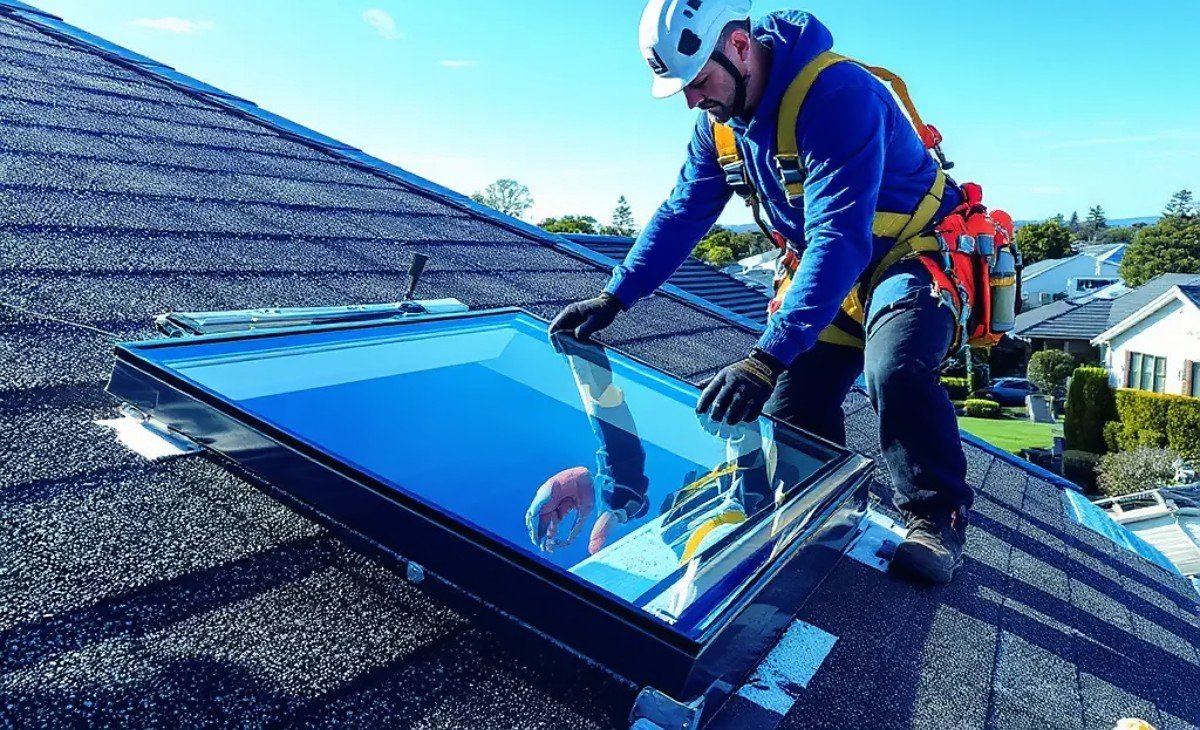
Skylight installation can be quite complicated. The team must understand the fundamentals of the roof’s structure, of sealing roofs watertight, and the design and overall look of the home. Below is an outline that Premium Quality Roofing uses that demonstrates the care they put into the installation of skylights.
The Initial Consultation and Site Prep
Each project starts with an evaluation. It is where we examine the roof and see if it is of truss design or is constructed with rafters. It also helps us understand where the sun will be located. North-facing skylights will receive direct sunlight, while those facing south will receive less consistent lighting.
The Structural Cut
It is the point of no return and will be the last step before the roof can be removed. We will mark off with a cut that we will replace the roof. The Premium Quality Roofing team will take care of your home and will make any additional structures that will need to be put in place to replace rafters.
The Flashing: Our Specialty
Not to make light of the situation, but we hope you’ve heard the horror story about the leaky skylight, which was caused by poor flashing. We enfold each of our membranes with the utmost security, including the flashing. It forms a weather-tight seal where the skylight frame meets the roof. We take our time to ensure the flashing is done correctly, no matter the type of roofing you have: tile, metal, or membrane.
Internal Finish
The installation is complete after the glass is placed. We build the “light shaft”—the tunnel extending from the skylight to your ceiling. It is wrapped, plastered, and painted so that the new skylight blends seamlessly with your home.
The Science of Heat and Glazing
Many homeowners become concerned with heat gain or loss after a new installation. We’ve developed our own advanced glazing to help deal with this. To make it worse, we have to deal with the intense UV of New Zealand.
When evaluating if the new skylight will be energy efficient, we look at the amount of heat that will be lost or gained through the glass. There is a specific equation used to capture heat gain.
$$Q = (U \times A \times \Delta T) + (SHGC \times A \times E_s)$$
Where:
- $Q$ is the total heat gain (Watts).
- $U$ is the U-value (thermal conductivity).
- $A$ is the area of the glass.
- $\Delta T$ is the temperature difference between inside and outside.
- $SHGC$ is the Solar Heat Gain Coefficient.
- $E_s$ is the solar irradiance.
When we select the best performance double-glazed units with Low-E coating, we manage to shrink the “U-value” and manipulate the “SHGC,” which will keep the room cool during the summer and warm in winter.
Commercial Skylight Installation: Boosting Productivity
The benefit of skylights is not limited to homes. Commercial structures, warehouses, and offices can achieve a high return on investment (ROI) with a professional skylight installation.
Research shows that employees are more productive and have a higher sense of well-being when they are able to work in natural light. For a business owner, this is a means of improving your employees’ work output. Additionally, in large retail spaces, natural light enhances the look of merchandise, which increases customer interest.
Why is Premium Quality Roofing a good option for your installation?
Why not hire a general builder for your skylight? The key is in the “envelope”. Builders know the inside of the house. Roofers know the outside.
Years of Experience with NZ Climate
We understand the unique challenges of Aotearoa. Our wind loads are some of the highest in the world, and our rain can be relentless. We choose skylight products that are specifically tested for these conditions.
Seamless Integration
As we do roof repairs, painting, and installations, we ensure your new skylight works and looks good with the rest of your house. We won’t leave messy sealant or torn edges. Our work is professional and warranty-covered, to remain unsealed.
Focus on Natural Light
We won’t just ‘put a window in your roof’. We talk with you about strategies to improve your light access. We consider the sun’s angle throughout the year to avoid glare on the TV or hot spots on the kitchen island.
Maintenance: Maintaining Your View
Once your installation is complete, there is maintenance to be done to keep your skylight looking good for as long as possible. Most modern glass comes with “neat” or self-cleaning compliance, meaning that when installed, streaks and marks will be eliminated on their own with the UV rays and rain.
Still, we recommend professional skylight check-ups every couple of years. We examine the seals, channel flashing, and if there are moving parts, we make sure they’re lubricated. Looking after your skylight will help ensure that it continues to let light shine through in your home for several years to come.
Getting Started: Your Free Quote
Getting a new skylight installed is a custom project. Every roof is different. Each homeowner has different requirements. We believe in offering a detailed, non-committal free quote.
When you reach out to us, we won’t give you a price over the phone. We will visit your home, go onto the roof, look at the ceiling space, and understand your requirements. From there, we will outline the plan for your installation, which will include:
- The specific skylight model is recommended.
- The structural requirements.
- The timeline for the installation.
- A transparent breakdown of costs.
Conclusion: A Brighter Future Awaits
Winter doesn’t equate to the continued experiences of dark evenings in cold rooms. It’s time for the functional and elegant interiors of your home to break free from the restraints of darkness. A skylight is your home’s architectural means for a warm welcome to the outdoors.
Premium Quality Roofing can help whether you desire to see the sun rise in your bedroom or have an intention to convert a gloomy corridor into a bright and inviting gallery. Out of consummate knowledge and a passion for daylight, we offer the region’s most reliable services in skylight installations.
Your imagination is the only limitation. Let’s grab hold of some.
To adjust the way you look at life, get in touch with Premium Quality Roofing for a complimentary estimate to see how a New Skylight Installation can help you adjust the way you look at life.

Frequently Asked Questions (FAQs) About Skylight Installation
Q1: Is it true that all skylights eventually leak?
A: This is a common misconception when considering a skylight installation. Every skylight is designed to be a sealed unit, and if there are leaks, it is not the fault of the skylight itself. Poor installation of skylights is the more likely source of leaks during installation, as a poor understanding of roofing systems can lead to water ponding. As professional roofers, first and foremost, we apply the same rigour to the seal around your new skylight as membrane roof systems. It means that the seal around the skylight will be designed to be as watertight as the other systems of your roof.
Q2: Will a new skylight turn my room into a greenhouse in summer?
A: We can assure you that it will not be the case. The old single-pane skylights have a reputation for heat gain; however, with the recent advances in glazing technology, that is no longer a fear with double glazing and low-e coatings, as the low-e coatings reflect infrared heat. It means you can enjoy the outside light as it will be let in, and the heat that causes sweating will be kept out. It is not the only option, however, as we also have solar-powered blinds that you can operate to close them during the hottest part of the day to further assist in managing heat.
Q3: How loud is the rain on a skylight?
A: There is something comforting about the sound of rain. However, we understand you don’t want it sounding like a drum kit over your head. The majority of skylight installations use laminated, double-glazed glass, which is extremely effective at noise reduction. In fact, it is often quieter than rain falling on long-run metal roofing!
Q4: Do I need building consent for a new skylight installation in NZ?
A: If you are not making a significant alteration to the structural “bones” of the roof (such as cutting through major trusses), it is likely that a skylight would be considered a “like-for-like” or minor alteration that does not require full building consent. However, each council is different. As part of our work, we assess the local laws to make sure your new installation is compliant with the NZ Building Code.
Q5: Can you install a skylight on a flat roof?
A: Sure! People often think about skylights as something that goes on pitched roofs. Flat roofs are great for skylight installations. For these types of surfaces, we tend to do what’s called a “curb-mounted” skylight installation. It means we build a small curb for the glass to ensure that water moves away from the glass, and this is a simple and effective way of adding sunlight to modern, minimalist-looking homes.
Q6: How do I clean a skylight that is high up on the ceiling?
A: Most new glass units come with a “self-cleaning” or “neat” coating. It isn’t magic, but it is almost close! The coating interacts with the sun and breaks down the small organic molecules, and then during the next rain event, the water sheets off from the glass and takes the dirt with it. For the inside side, a long-handled microfiber mop tends to do the job in a cleaning event or two.
Q7: What is the best room for a skylight?
A: While bathrooms and kitchens are certainly the most popular options (because they also benefit from the ventilation an opening skylight provides), we’ve seen a new skylight work wonders in dark hallways, walk-in wardrobes, and even windowless laundry rooms. Any space in which you’ve found yourself flipping a light switch during the day is a prime target for more natural light and a skylight.
Q8: How long does the actual installation take?
A: The disruption phase is really short. We usually complete skylight installations, roof sealing, and unit placements within a single day. Internal finishes (which include plaster and paint for the light shaft) might take an extra day or two. Still, you can rely on the fact that we’re going to make your home weather-tight before leaving on day one.
Pro Tip: Considering North Facing
As for your new skylight, keep in mind that the north-facing position is going to provide the most light (in an unruly kind of way) in the Southern Hemisphere. However, if it’s for an art studio or home office, a south-facing position might be best for a softer, more consistent light to avoid harsh shadowing. Based on the methods of creating titles and meta descriptions, here’s what I’ve come up with for your skylight installation site.